
What Is Design Engineering?
What is design engineering? Learn how design, content, interaction, and engineering work together to create digital experiences that are visually coherent, interactive, usable, and technically sound.

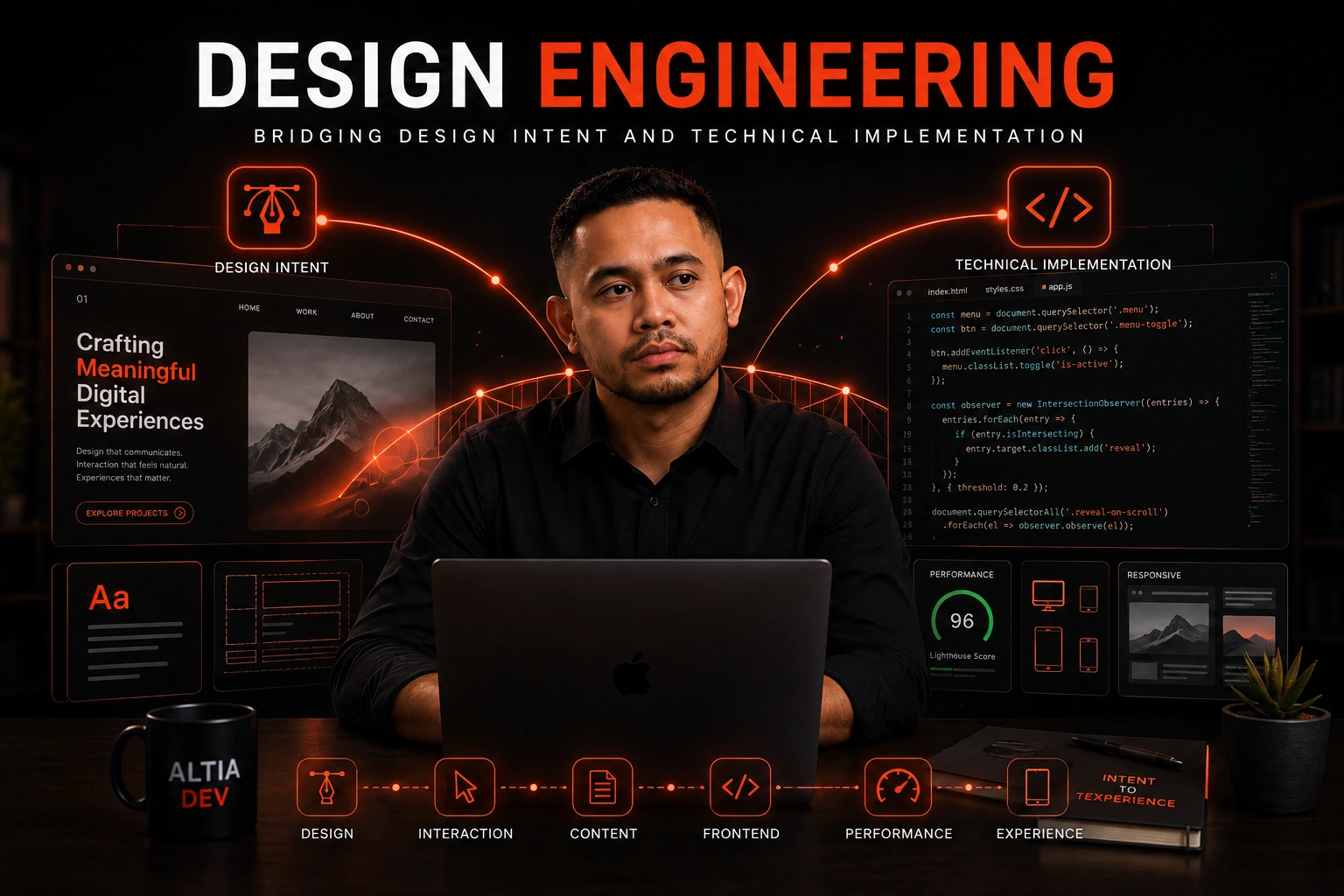
Table of Contents
A website can look perfect in Figma and still feel completely different once it becomes a real product.
The typography may be right. The spacing may be right. The colors may be right.
Yet something can still feel wrong.
The animation feels disconnected. The interaction feels flat. The mobile layout breaks the original composition. The page loads too slowly. A headline that looked balanced in the design becomes awkward when real content is added.
This happens because a digital experience is not a static design.
It is a system.
Design defines intent. Engineering turns that intent into behavior. Content gives the interface meaning. Technology introduces both possibilities and constraints.
This is where design engineering becomes useful.
Design engineering connects design intent with technical implementation to create digital experiences that are visually coherent, interactive, usable, and technically sound.
It is not simply about making designers learn how to code.
It is about treating design and engineering as disciplines that continuously influence each other.
Design and Engineering Were Never Really Separate #
Traditional workflows often make the relationship look simple:
Design
   ↓
Handoff
   ↓
Development
   ↓
Website
This suggests that design is completed first and engineering simply implements it.
That model can work for straightforward interfaces.
But modern digital experiences are rarely static.
A design now has to account for:
At the same time, engineering decisions influence what the experience can become.
The relationship is therefore closer to:
Design
   ↕
Interaction
   ↕
Content
   ↕
Frontend
   ↕
Performance
   ↕
Technology
Each layer affects the others.
A design decision can create an engineering constraint.
An engineering constraint can require a design decision.
That feedback loop is at the heart of design engineering.
What Design Engineering Actually Means #
Design engineering is sometimes reduced to a simple description:
A designer who can code.
That definition is too narrow.
Coding is certainly useful, particularly when working with modern web interfaces, but the discipline is more about connecting two ways of thinking.
Design asks:
What should this experience feel like?
What should the user understand?
What should attract attention?
How should the interface communicate?
Engineering asks:
How should it behave?
How should it scale?
How should it perform?
What are the technical constraints?
How should it be implemented?
Design engineering brings those questions together.
Design Intent
      ↓
Technical Interpretation
      ↓
Implementation
      ↓
Interaction
      ↓
Real Experience
The objective is not to make design and engineering identical.
The objective is to make them work together.
The Gap Between Design and Production #
One of the biggest challenges in digital work happens between the design file and the browser.
Consider a typical process:
Figma
  ↓
Implementation
  ↓
Browser
  ↓
Device
  ↓
User
At every step, new variables appear.
A static design does not tell you everything about:
A production interface has to answer those questions.
This is why visual fidelity alone is not enough.
A successful implementation needs to preserve the intent of the design while adapting it to the realities of the web.
What a Design Engineer Actually Thinks About #
Design engineering sits across several areas that are often treated separately.
Visual Design #
A design engineer needs to understand the fundamentals of visual communication:
This does not necessarily mean replacing a dedicated visual designer.
It means understanding what the visual decisions are trying to achieve.
Interaction #
A digital interface is defined partly by how it behaves.
Consider:
Hover
Click
Scroll
Transition
Loading
Error
Success
These states are part of the experience.
A button is not simply a rectangle with text.
A navigation menu is not simply a collection of links.
A page transition is not simply an animation.
Each interaction communicates something to the user.
Good design engineering therefore asks:
What should happen, and why?
before asking:
How do we implement it?
Content #
Content is often treated as something added after the interface has been designed.
That can create problems.
The length of a headline can change the composition.
The amount of body copy can change the vertical rhythm.
The number of items in a navigation can change the layout.
An image's aspect ratio can change the visual balance.
A design that only works with placeholder content is not necessarily a production-ready design.
Content and design therefore need to be considered together.
Content
   ↕
Layout
   ↕
Interaction
   ↕
Engineering
Frontend Behavior #
The browser is not a static canvas.
The same interface needs to work across:
Desktop
Tablet
Mobile
Different browsers
Different viewport sizes
Different input methods
A design engineer thinks beyond the ideal viewport.
The question becomes:
How does this experience behave when reality is different from the design file?
That is an engineering question, but it is also a design question.
Performance #
An interface can look exceptional and still provide a poor experience if it takes too long to become usable.
Performance therefore belongs in the design conversation.
Large images, excessive JavaScript, complex animations, unnecessary dependencies, and inefficient rendering can all affect the final experience.
This does not mean every design needs to be simplified.
It means the experience should be designed with technical reality in mind.
Technical Constraints #
Engineering introduces constraints.
Some interactions may be expensive.
Some visual effects may be difficult to maintain.
Some animations may create accessibility or performance concerns.
Some designs may depend on content structures that the backend cannot realistically provide.
The answer is not always to reject the design.
It is to understand the trade-off.
Sometimes the right solution is:
Keep the visual intent
        ↓
Change the implementation
Sometimes:
Keep the technical architecture
        ↓
Adjust the interaction
And sometimes both sides need to change.
That is normal.
Why Good UI Is Not Enough #
A polished interface does not automatically create a good digital experience.
Good UI
   ≠
Good Experience
A website can have:
and still feel:
A stronger model is:
Visual Design
      +
Content
      +
Interaction
      +
Technology
      +
Performance
      ↓
Digital Experience
This is why design engineering is broader than UI implementation.
The goal is not simply to make a screen look correct.
The goal is to make the entire experience work.
Design Engineering Is About Systems, Not Screens #
A screen is only one part of a digital product.
Consider a typical journey:
Homepage
   ↓
Navigation
   ↓
Content
   ↓
Interaction
   ↓
Conversion
   ↓
Application
   ↓
Backend
   ↓
CMS
Each part influences the experience.
A beautiful homepage cannot compensate for poor information architecture.
A sophisticated animation cannot compensate for unclear content.
A clean interface cannot compensate for a slow application.
A technically elegant backend cannot compensate for a confusing user journey.
Design engineering therefore requires thinking in systems.
The question is not only:
"Does this screen look good?"
It is also:
"How does the entire experience behave as a system?"
A Real-World Example #
This approach becomes particularly relevant when building design-led digital experiences.
For example, projects such as Mansor Customs and Saptawell involve more than translating visual direction into HTML and CSS.
The work can be understood as a sequence:
Brand Direction
      ↓
Visual System
      ↓
Content Structure
      ↓
Interaction Design
      ↓
Frontend Implementation
      ↓
Performance
      ↓
Digital Experience
The engineering decisions are part of the experience.
The same applies in the other direction.
The design decisions influence how the frontend should be structured, how components should behave, and where technical complexity is actually justified.
This is the type of relationship we mean when we use the term Creative Engineering.
The point is not that every project requires the same process.
The point is that design and engineering should be allowed to inform each other rather than being treated as a one-way handoff.
When Does Design Engineering Matter Most? #
Not every project needs the same level of design engineering.
It becomes particularly valuable when the experience itself is a major part of the product.
Brand-Driven Websites #
For areas such as:
Luxury
Automotive
Hospitality
Fashion
Architecture
Lifestyle
visual identity and interaction often play a significant role in communicating the brand.
Technical implementation therefore becomes part of the brand experience.
Product Experiences #
For:
SaaS
E-commerce
Customer Portals
Interactive Platforms
behavior becomes just as important as appearance.
The interface needs to work across many states and real-world conditions.
Content-Heavy Experiences #
For:
Editorial
Knowledge Platforms
Portfolios
Media
content structure becomes deeply connected to the interface.
The system needs to accommodate real content rather than idealized placeholder content.
Highly Interactive Websites #
For:
Animation
Motion
Scroll Interaction
Interactive Storytelling
the implementation itself becomes a significant part of the experience.
In these cases, the boundary between design and engineering becomes particularly thin.
Common Misconceptions #
Design Engineer Means Designer Who Can Code #
Not necessarily.
A design engineer needs technical capability, but the important skill is understanding the relationship between design decisions and implementation.
Design Engineering Is Just Frontend Development #
Frontend engineering is an important part of it.
But design engineering also considers:
The discipline sits at the intersection rather than entirely inside frontend development.
More Animation Means Better Design Engineering #
No.
Motion should have a purpose.
It can communicate hierarchy, provide feedback, establish continuity, or make an interaction easier to understand.
But adding motion simply because it looks impressive can make a website slower, harder to use, or visually noisy.
Good design engineering is about appropriate behavior, not maximum behavior.
Design Should Be Finished Before Development Starts #
For static deliverables, this can sometimes make sense.
For interactive digital experiences, the relationship is often more productive when design and engineering can influence each other throughout the process.
The browser is part of the medium.
Technical feedback can therefore improve the design.
Design feedback can improve the implementation.
How We Think About Design Engineering #
At ALTIA DEV, we do not see design as a handoff.
We see design as part of engineering.
And we do not see engineering as implementation only.
We see engineering as part of the experience.
That means asking questions across disciplines:
Does it look right?
        ↓
Does it communicate clearly?
        ↓
Does it behave correctly?
        ↓
Does it work across devices?
        ↓
Does it perform well?
        ↓
Can it be maintained?
        ↓
Does the technology serve the experience?
The objective is not to make technology visible for its own sake.
The objective is to use technology to make the intended experience possible.
Great digital experiences happen when design intent and engineering reality are developed together.
That is the core idea behind Creative Engineering at ALTIA DEV.
Conclusion #
Design engineering is not simply the combination of design skills and coding skills.
It is a way of approaching digital products where design and engineering continuously inform each other.
Design defines intent.
Content gives that intent meaning.
Interaction gives it behavior.
Engineering makes it real.
Performance determines whether the experience survives contact with real users and real devices.
The result is not just a collection of screens.
It is a digital experience.
The difference can be summarized simply:
Design
   ↓
Engineering
   ↓
Digital Experience
versus:
Design
   ↕
Content
   ↕
Interaction
   ↕
Engineering
   ↕
Technology
   ↓
Digital Experience
The second model is closer to how we believe modern digital experiences should be built.
Design should not stop at the handoff. Engineering should not stop at implementation.
They should work together to create something that actually works.
Related Work #
Related Projects #
Explore approved ALTIA DEV project work that demonstrates the relationship between design and engineering.
Related Articles #
Continue with:
Related Service #
Creative Engineering
Explore how ALTIA DEV combines design, technology, and engineering to build digital experiences and software systems.
Explore other insights on engineering, AI, design, and digital systems.

Human-in-the-Loop AI: Why Automation Should Not Mean No Review
Learn when AI should decide and when humans must stay in control — and how to design review workflows that automate the repetitive without removing accountability.
Alfredo Gemilang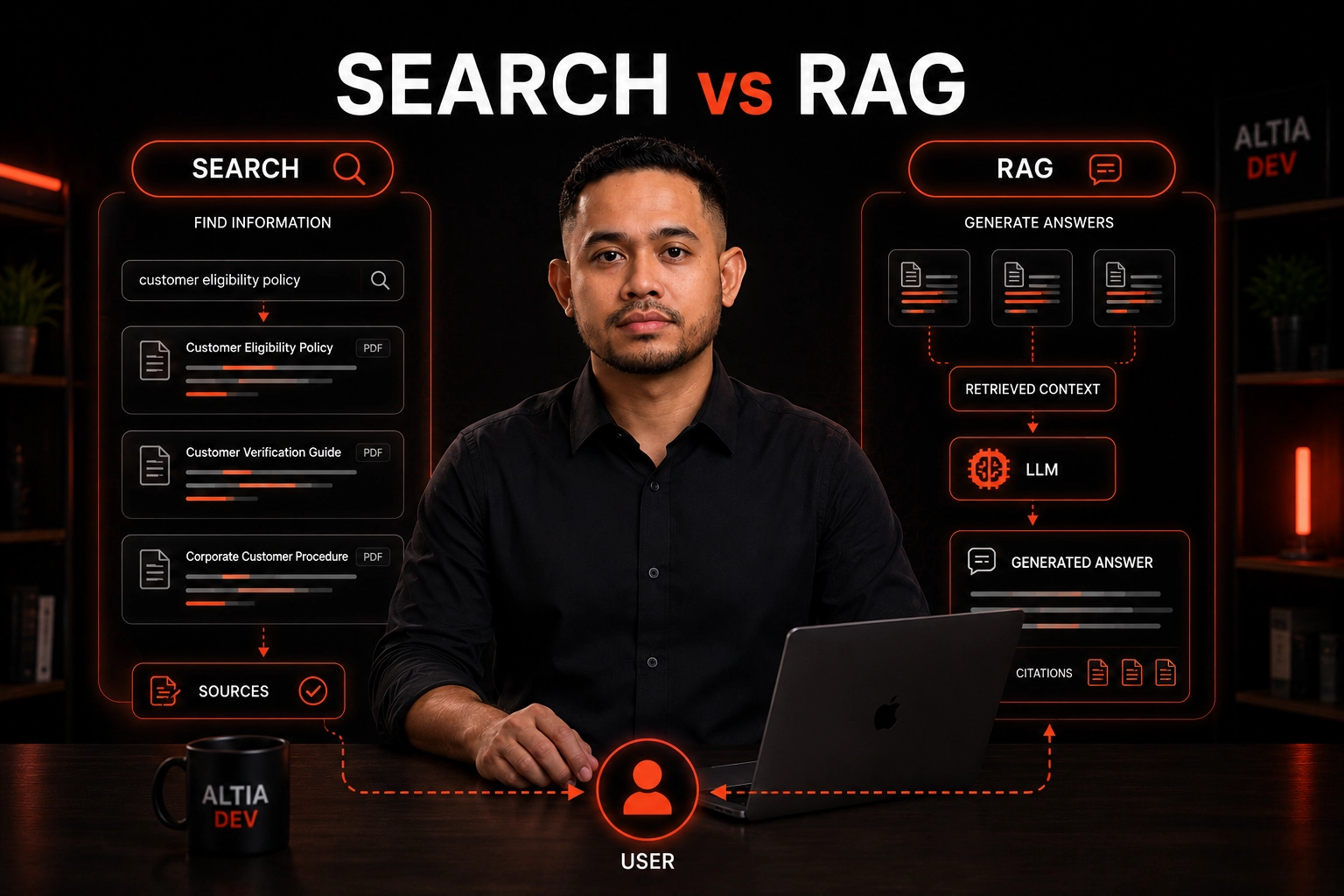
RAG vs Search: What Should a Business Knowledge System Use?
Should your knowledge system use search, RAG, or both? A practical guide to choosing the right architecture based on real product requirements.
Alfredo Gemilang
Meilisearch vs Vector Search: Which Should You Use?
Compare keyword, vector, and hybrid search to choose the right retrieval architecture for knowledge systems, AI applications, and enterprise search.
Alfredo Gemilang